Prepared by: Aetherix B.V. — Trusted Jetson Hardware Provider for Edge AI
Test platform: 8× NVIDIA DGX Spark (GB10) · Model: DeepSeek-V4.1-Flash (763B) · Report date: September 2026
Contents
- 1. Introduction
- 2. Hardware
- 3. Docker Images
- 4. TP8 Optimizations
- 5. Configuration
- 6. Memory Analysis
- 7. Performance Results
- 8. Comparative Analysis
- 9. SLO and Capacity
- 10. Lessons Learned
- 11. Conclusion
- Appendix A: Verification Commands
1. Introduction
This report documents the deployment of DeepSeek-V4.1-Flash (763B MoE) on 8× NVIDIA DGX Spark (GB10) using tensor parallelism (TP=8). It is the companion to the 4× DGX Spark TP4 deployment report; the model architecture, vLLM build chain, and SM 12.1a patches are described there and are not repeated here.
Two configurations were tested:
- TP8-300K (Engram in memory): 300K context; Engram tables are loaded into pinned host memory via stock vLLM, GMU 0.80, AutoTuner off.
- TP8-1M (Engram-on-disk): 1M context; Engram tables are held on local NVMe via the Engram-on-disk patch, GMU 0.75, AutoTuner on.
Both configurations use DSpark k=5 speculative decoding, CUDA graphs (FULL_AND_PIECEWISE mode), and vision and tool calling enabled.
Why two configurations? The Engram-on-disk patch stages rows into GPU memory before the forward pass, enabling CUDA graph capture. At 300K context, however, the unified memory across 8 ranks is enough to hold Engram in pinned host memory instead. The 300K-memory configuration tests whether the simpler stock path is faster when context is bounded; the 1M-disk configuration raises the configured context ceiling. The benchmarks use short prompts and do not test the maximum context length.
2. Hardware
| Component | Value |
|---|---|
| GPU | Blackwell architecture (GB10), SM 12.1a (CC 12.1), 48 SMs |
| GPU memory | 128 GB unified LPDDR5X (shared CPU+GPU) per node |
| Memory bandwidth | ~273 GB/s (unified) per node |
| FP4 peak performance (with sparsity) | ~1 PFLOP per node |
| CPU | 20-core Arm (10× Cortex-X925 + 10× Cortex-A725) per node |
| Node interconnect | NVIDIA ConnectX-7, 200 Gb/s RDMA (QSFP) |
| Storage | 8× NVMe SSD (1× 1 TB + 7× 4 TB; 8 nodes total) |
| Network topology | 200 GbE switch (no NVLink; all-reduce over Ethernet) |
8 nodes × 128 GB = 1024 GB total unified memory across the cluster.
Critical architectural fact: There is no NVLink between DGX Sparks. TP=8 in this report is multi-node tensor parallelism over the ConnectX-7 200 GbE network — every all-reduce crosses the Ethernet fabric through the 200 GbE switch.
3. Docker Images
Two images are used, both derived from the same base image as the TP4 deployment. The first (vllm-dsv41:latest) is that base image itself; the second (vllm-dsv41:engram-mem) is built on top of it.
3.1 vllm-dsv41:latest (7 patches, Engram-on-disk)
Used by the TP8-1M configuration. Identical to the TP4 image — all 7 SM 12.1a patches baked in, including Engram-on-disk. See the TP4 deployment report, Section 4 for the full patch list and build instructions.
3.2 vllm-dsv41:engram-mem (4 patches, Engram in memory)
Used by the TP8-300K configuration. Built on top of vllm-dsv41:latest with the three Engram patch files reverted to the original vLLM versions:
FROM vllm-dsv41:latest
COPY vllm/vllm/models/deepseek_v4_1/common/engram.py /usr/local/lib/python3.12/dist-packages/vllm/models/deepseek_v4_1/common/engram.py
COPY vllm/vllm/model_executor/model_loader/weight_utils.py /usr/local/lib/python3.12/dist-packages/vllm/model_executor/model_loader/weight_utils.py
COPY vllm/vllm/models/deepseek_v4_1/nvidia/model_state.py /usr/local/lib/python3.12/dist-packages/vllm/models/deepseek_v4_1/nvidia/model_state.py
ENTRYPOINT []
The remaining 4 patches (attention, FlashInfer sparse, SWA, sparse indexer) are kept. With the original Engram handling, the tables load into pinned host memory and the forward pass makes a host round-trip on each step — CUDA graphs cannot capture the Engram lookup.
| Image | Engram.py | model_state.py | weight_utils.py | attention.py | flashinfer_sparse.py | sparse_swa.py | sparse_attn_indexer.py |
|---|---|---|---|---|---|---|---|
vllm-dsv41:latest |
patched | patched | patched | patched | patched | patched | patched |
vllm-dsv41:engram-mem |
original | original | original | patched | patched | patched | patched |
4. TP8 Optimizations
TP=8 introduces 8-rank NCCL communication, which requires optimizations not needed at TP=4.
4.1 NCCL Channel Reduction
At TP=8, NCCL defaults to 64 channels — approximately 37 GB of overhead per rank. Three environment variables reduce this:
| Setting | Value | Effect |
|---|---|---|
NCCL_MAX_NCHANNELS |
8 |
64 → 8 channels (~26 GB saved per rank) |
NCCL_BUFFSIZE |
1048576 |
4 MiB → 1 MiB buffer |
NCCL_NVLS_ENABLE |
0 |
GB10 has no NVLink SHARP |
4.2 Container Limits
| Setting | Value | Reason |
|---|---|---|
ulimit: nofile |
1048576:1048576 |
NCCL 2.30 8-rank socket accept limit |
ulimit: memlock |
-1:-1 |
RDMA memory pinning (ibv_reg_mr) |
ulimit: stack |
67108864 |
64 MB stack |
cap_add: IPC_LOCK |
— | RDMA memory pinning capability |
memory_limit |
112g |
Leave 9 GB for OS (121 GB total) |
Without memlock=-1:-1 and IPC_LOCK, NCCL initialization fails with ibv_reg_mr_iova2 failed with error Cannot allocate memory.
4.3 NCCL Environment
NCCL_IB_ROCE_VERSION_NUM: '2'      # RoCE v2
NCCL_IB_ADDR_FAMILY: 'AF_INET'     # IPv4
NCCL_NVLS_ENABLE: '0'              # No NVLink SHARP on GB10
NCCL_IB_MERGE_NICS: '0'           # No NIC merge
NCCL_CROSS_NIC: '1'               # Cross-NIC
NCCL_IGNORE_CPU_AFFINITY: '1'     # Ignore CPU affinity
NCCL_CUMEM_ENABLE: '0'             # NCCL cumem off
TORCH_NCCL_ASYNC_ERROR_HANDLING: '1'
NCCL_DEBUG: 'WARN'
5. Configuration
5.1 TP8-300K (Engram in memory)
| Parameter | Value | Description |
|---|---|---|
| Image | vllm-dsv41:engram-mem |
Stock Engram handling |
tensor_parallel |
8 | 8 nodes × 1 GPU |
gpu_memory_utilization |
0.80 | 80% GMU |
max_model_len |
300000 | 300K context |
max_num_seqs |
8 | Max 8 concurrent sequences |
max_num_batched_tokens |
8192 | Prefill batch size |
block_size |
128 | KV cache block size |
distributed-executor-backend |
mp | Multiprocess backend |
| AutoTuner | off (VLLM_FLASHINFER_AUTOTUNE: '0') |
Prevents OOM spike |
5.2 TP8-1M (Engram-on-disk)
| Parameter | Value | Description |
|---|---|---|
| Image | vllm-dsv41:latest |
Engram-on-disk patch active |
tensor_parallel |
8 | 8 nodes × 1 GPU |
gpu_memory_utilization |
0.75 | 75% GMU (lower for 1M KV headroom) |
max_model_len |
1048576 | 1M context |
max_num_seqs |
8 | Max 8 concurrent sequences |
max_num_batched_tokens |
8192 | Prefill batch size |
block_size |
128 | KV cache block size |
distributed-executor-backend |
mp | Multiprocess backend |
DSV41_ENGRAM_DISK |
1 | Engram rows on local NVMe |
| AutoTuner | on (default) | Sufficient memory headroom |
5.3 Speculative Decoding (both)
{
  "method": "dspark",
  "num_speculative_tokens": 5,
  "draft_sample_method": "probabilistic",
  "rejection_sample_method": "block",
  "enable_adaptive_verification": false
}
5.4 Launch Command
# TP8-300K (Engram in memory)
sparkrun run /home/nvidia/.cordatus-sparkrun/recipes/deepseek-v41-flash-tp8.yaml \
  --hosts 192.168.1.153,192.168.1.147,192.168.1.157,192.168.1.158,192.168.1.161,192.168.1.162,192.168.1.166,192.168.1.148 \
  --foreground

# TP8-1M (Engram-on-disk)
sparkrun run /home/nvidia/.cordatus-sparkrun/recipes/deepseek-v41-flash-tp8-1m.yaml \
  --hosts 192.168.1.153,192.168.1.147,192.168.1.157,192.168.1.158,192.168.1.161,192.168.1.162,192.168.1.166,192.168.1.148 \
  --foreground
6. Memory Analysis
6.1 TP8-300K (Engram in memory)
| Component | GB/rank |
|---|---|
| Model (GPU) | 49.55 |
| Engram (pinned host) | 23.60 |
| NCCL (8 channels) | ~11 |
| CUDA graphs | ~1.5 |
| Total | ~85.5 |
| GMU=0.80 budget | 96.8 |
| KV cache | ~8.7 GB (1.46M tokens) |
6.2 TP8-1M (Engram-on-disk)
| Component | GB/rank |
|---|---|
| Model (GPU, without Engram) | 38 |
| NCCL (8 channels) | ~11 |
| AutoTune spike | ~10 |
| CUDA graphs | ~1.5 |
| Total | ~60.5 |
| GMU=0.75 budget | 90.75 |
| KV cache | ~30 GB |
| 1M context requirement | ~3.7 GB |
| Free headroom | ~26 GB |
The Engram-on-disk configuration reports more memory allocated to KV cache (~30 GB vs ~8.7 GB) and a 1M configured context limit. Table placement, memory settings and execution paths all differ, so the measured speed difference is not an isolated disk-I/O penalty. See Conditional Memory and Offloading in LLM Inference for the mechanism and the same-hardware comparison.
7. Performance Results
7.1 TP8-300K (Engram in memory)
Measurements were taken with CordatusAI/llm-benchmark.
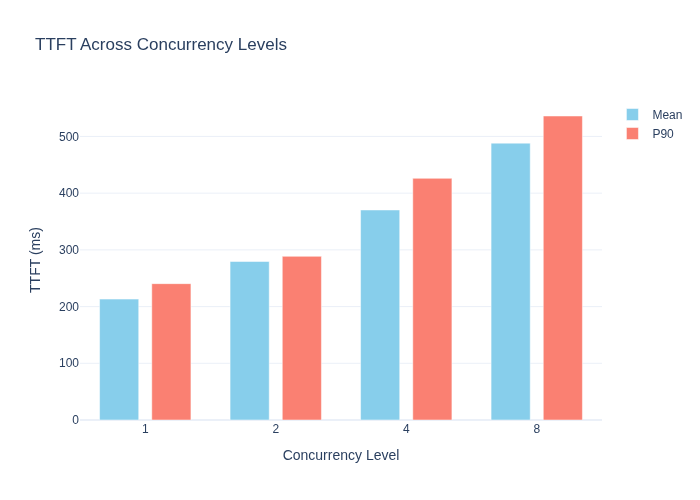
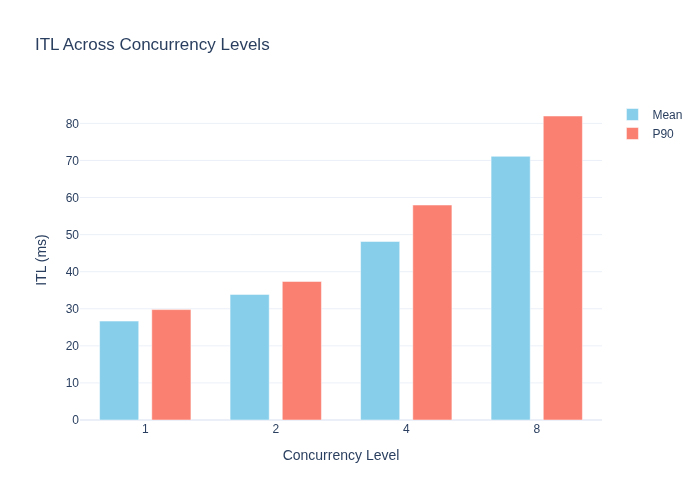
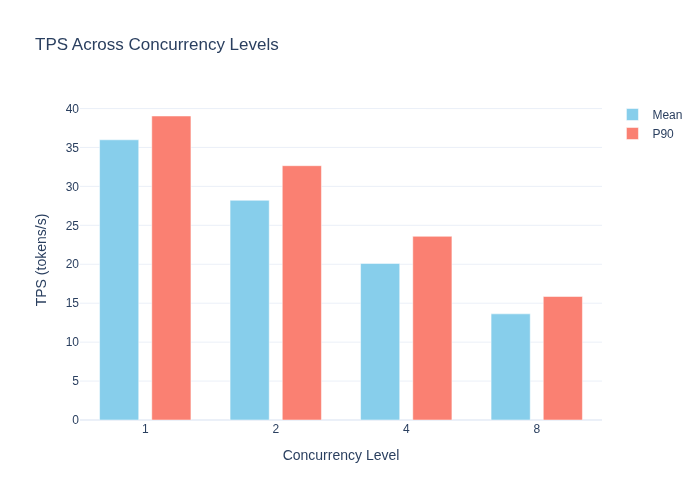
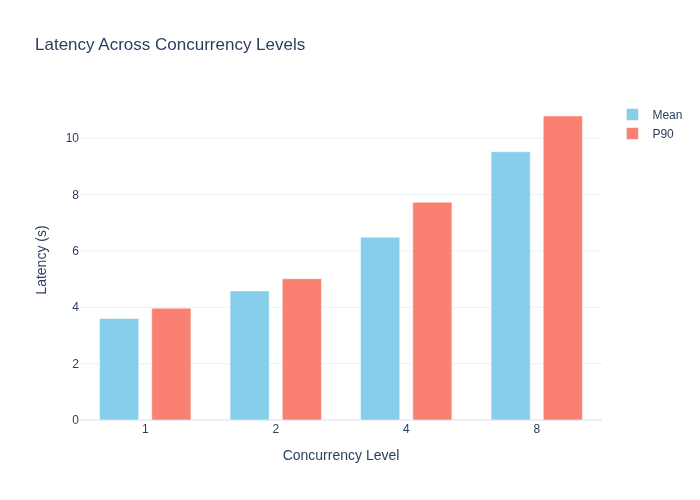
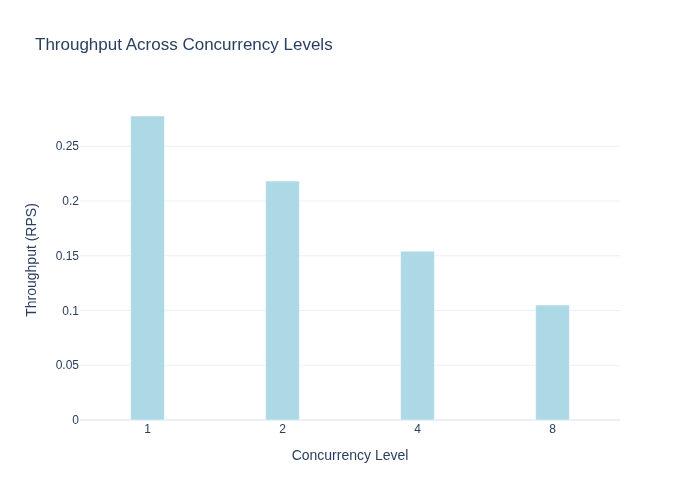
| Concurrency | TTFT (ms) | ITL (ms) | TPS (tok/s) | Latency (s) | Throughput (RPS) |
|---|---|---|---|---|---|
| 1 | 213.19 | 26.67 | 35.98 | 3.60 | 0.28 |
| 2 | 279.55 | 33.87 | 28.21 | 4.58 | 0.22 |
| 4 | 370.36 | 48.16 | 20.10 | 6.49 | 0.15 |
| 8 | 488.22 | 71.12 | 13.63 | 9.52 | 0.11 |
7.2 TP8-1M (Engram-on-disk)
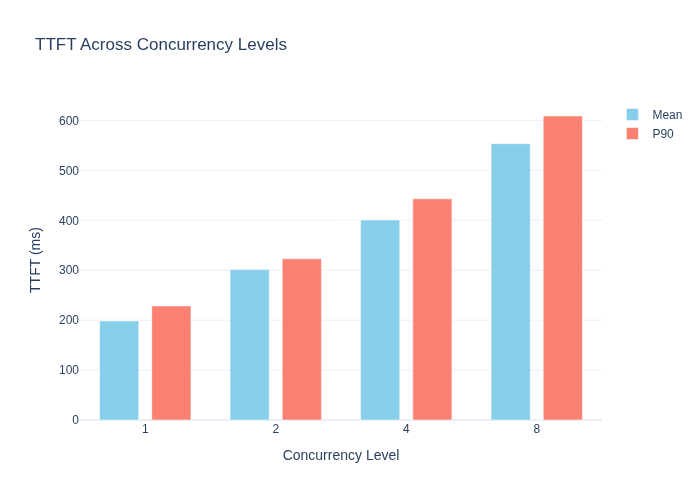
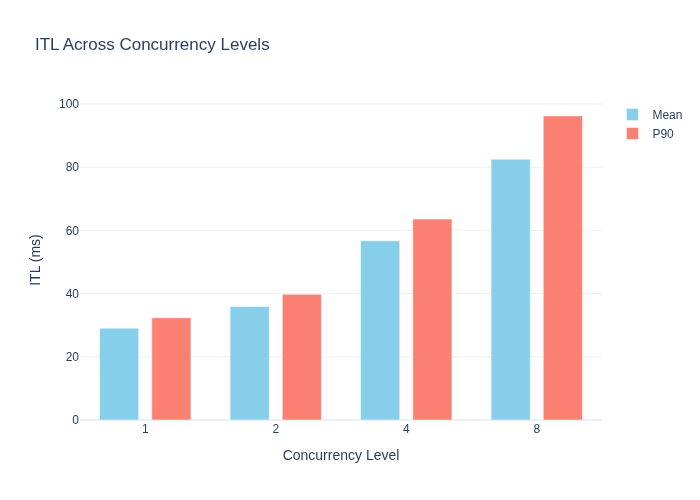
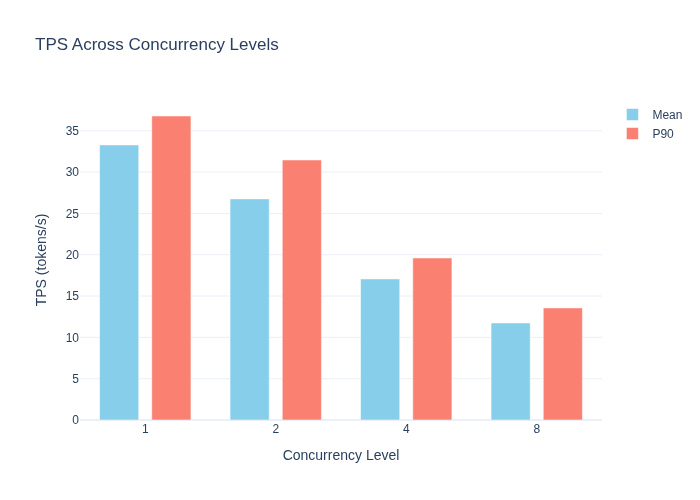
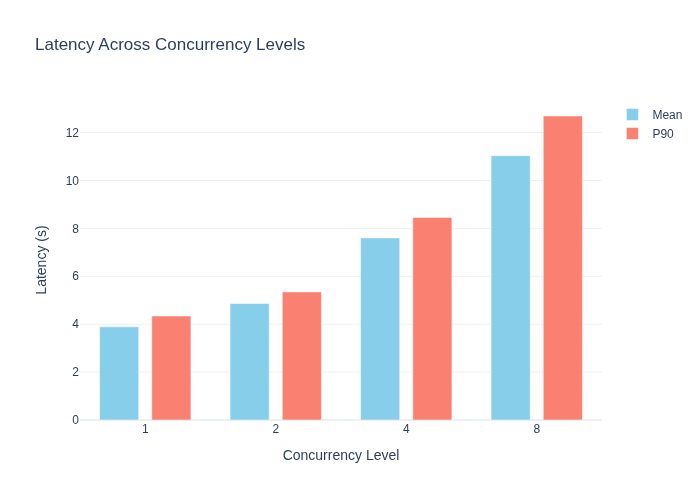
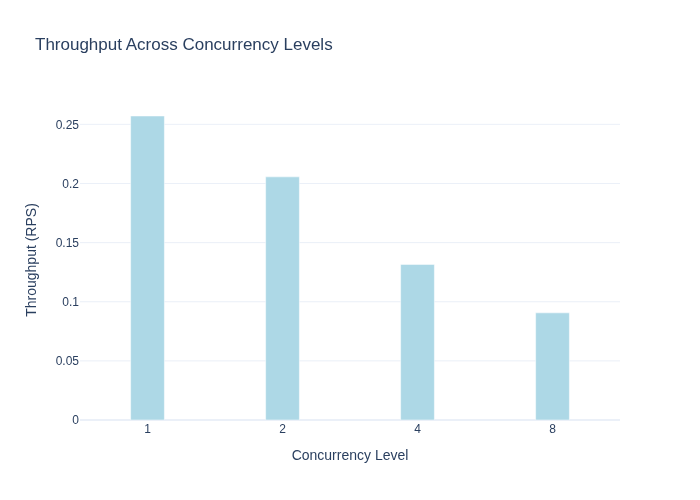
| Concurrency | TTFT (ms) | ITL (ms) | TPS (tok/s) | Latency (s) | Throughput (RPS) |
|---|---|---|---|---|---|
| 1 | 198.54 | 29.06 | 33.28 | 3.89 | 0.26 |
| 2 | 301.32 | 35.92 | 26.76 | 4.86 | 0.21 |
| 4 | 400.58 | 56.68 | 17.07 | 7.60 | 0.13 |
| 8 | 553.68 | 82.54 | 11.74 | 11.04 | 0.09 |
7.3 Charts — TP8-300K (Engram in memory)
7.4 Charts — TP8-1M (Engram-on-disk)
7.5 Assessment
- TP8-300K has higher TPS than TP8-1M at every tested concurrency level (35.98 vs 33.28 at C=1). This compares the complete configurations; the measurements do not isolate the effects of table placement, context settings, CUDA graphs or AutoTuner.
- TTFT at C=1 is lower for the 1M configuration (199 ms vs 213 ms). The execution paths differ; this measurement alone does not identify the cause.
- Max C = 4 for TP8-300K and 2 for TP8-1M at the Benchmark Explorer’s default targets (TTFT≤1000ms, TPS≥20 tok/s). TP8-300K doubles the TP4 capacity (Max C=2); TP8-1M reaches 17.07 tok/s at C=4, just under the TPS target.
- TPS decline from C=1 to C=8: 62% drop (300K), 65% drop (1M) — memory bandwidth contention as the cluster approaches saturation.
8. Comparative Analysis
8.1 TP4 vs TP8 vs B300
| Concurrency | TP4 TPS | TP8-300K TPS | TP8-1M TPS | B300 TPS |
|---|---|---|---|---|
| 1 | 29.48 | 35.98 | 33.28 | 284.54 |
| 2 | 21.32 | 28.21 | 26.76 | 294.56 |
| 4 | 13.09 | 20.10 | 17.07 | 252.60 |
| 8 | 8.79 | 13.63 | 11.74 | 209.41 |
TP8-300K is 22% faster than TP4 at C=1 (35.98 vs 29.48) and 55% faster at C=8 (13.63 vs 8.79). The scaling is sublinear because the model is memory-bandwidth-bound and TP=8 adds all-reduce overhead across 8 nodes.
B300 remains ~8× faster than TP8-300K at C=1 (284.54 vs 35.98) — the HBM3e bandwidth difference (~8 TB/s vs 273 GB/s) dominates.
8.2 TTFT Comparison
| Concurrency | TP4 TTFT (ms) | TP8-300K TTFT (ms) | TP8-1M TTFT (ms) |
|---|---|---|---|
| 1 | 271.63 | 213.19 | 198.54 |
| 2 | 395.75 | 279.55 | 301.32 |
| 4 | 577.41 | 370.36 | 400.58 |
| 8 | 805.89 | 488.22 | 553.68 |
TP8 reduces TTFT by 21-39% compared to TP4 at all concurrency levels — prefill is compute-bound and 8 ranks provide more aggregate FLOPS.
9. SLO and Capacity
At the Benchmark Explorer’s default targets (TTFT≤1000ms, TPS≥20 tok/s), TP8-300K yields Max C = 4 — double the TP4 capacity (Max C = 2) — and TP8-1M yields Max C = 2:
| SLO | Threshold | TP8-300K C=4 | TP8-1M C=4 |
|---|---|---|---|
| TTFT | ≤ 1000 ms | 370 ms ✓ | 401 ms ✓ |
| TPS | ≥ 20 tok/s | 20.10 ✓ | 17.07 ✗ |
Warning: At C=8, TPS drops below the 20 tok/s threshold for both configurations (13.63 and 11.74), and TP8-1M already misses it at C=4. For interactive chat services, 4 concurrent users (TP8-300K) or 2 (TP8-1M) are recommended; for higher loads, data center hardware (B300/GB300) should be preferred.
10. Lessons Learned
- NCCL 8-rank overhead is significant. The default 64 channels consume ~37 GB/rank.
NCCL_MAX_NCHANNELS=8andNCCL_BUFFSIZE=1048576reduce this to ~11 GB — a critical optimization without which the model cannot fit. memlock=-1andIPC_LOCKare mandatory for 8-rank RDMA. Without them, NCCL initialization fails withibv_reg_mr_iova2 failed with error Cannot allocate memory.nofile=1048576is required for NCCL 2.30. The 8-rank socket accept exceeds the container’s default soft limit of 1024.- The disk configuration has lower measured C=1 TTFT (199 ms vs 213 ms). It stages rows before the forward pass, but the comparison does not isolate that change from the other configuration differences.
- AutoTuner can cause OOM.
VLLM_FLASHINFER_AUTOTUNE: '0'disables FlashInfer autotune but not DeepGEMM/CUTLASS mxfp8_gemm autotune, which consumes ~10 GB during profiling. The 1M configuration has sufficient headroom; the 300K configuration disables it. - sparkrun cluster management.
sparkrun cluster set-default <name>changes the active cluster;sparkrun cluster defaultonly displays it. - Docker
ENTRYPOINT []is mandatory. The stockvllm/vllm-openaiimage hasENTRYPOINT ["vllm","serve"], which prevents sparkrun from appending its command. The final image must clear the entrypoint.
11. Conclusion
- DeepSeek-V4.1-Flash (763B) runs on 8× DGX Spark with TP=8 — the larger cluster doubles the usable concurrency (Max C=4 vs Max C=2 at TP4) and improves TPS by 22-55%.
- Two configurations serve different use cases. TP8-300K (Engram in memory) has higher TPS on the measured short-prompt workload; TP8-1M (Engram-on-disk) leaves more KV-cache memory and configures a 1M context limit. Performance at that maximum context length was not measured.
- NCCL optimization is the critical TP8 delta. Without channel reduction and proper ulimits, the 8-rank overhead prevents the model from fitting.
- TP8 does not replace data center hardware. B300 is still ~8× faster at C=1, but TP8 brings the 763B model into the reach of a 2× capacity increase over TP4 — enough for development, prototyping, and limited-team production scenarios.
Appendix A: Verification Commands
API Health
curl http://192.168.1.153:8000/v1/models
Simple Test
curl http://192.168.1.153:8000/v1/chat/completions \
  -H 'Content-Type: application/json' \
  -d '{"model":"deepseek-v4.1-flash","max_tokens":50,
       "messages":[{"role":"user","content":"Count from 1 to 10."}]}'
Aetherix B.V. — aetherix.com · info@aetherix.com
Oude Apeldoornseweg 41, A1.08, 7333 NR Apeldoorn, Netherlands
This report was generated from measurements produced with the CordatusAI/llm-benchmark tool. Deployment recipe adapted from tonyd2wild/DeepSeek-V4.1-Flash-vLLM-DGX-Spark boot10 config and im0xMagnus/deepseek-v4.1-flash-uncensored-8x-dgx-spark TP8 port. Report date: September 2026